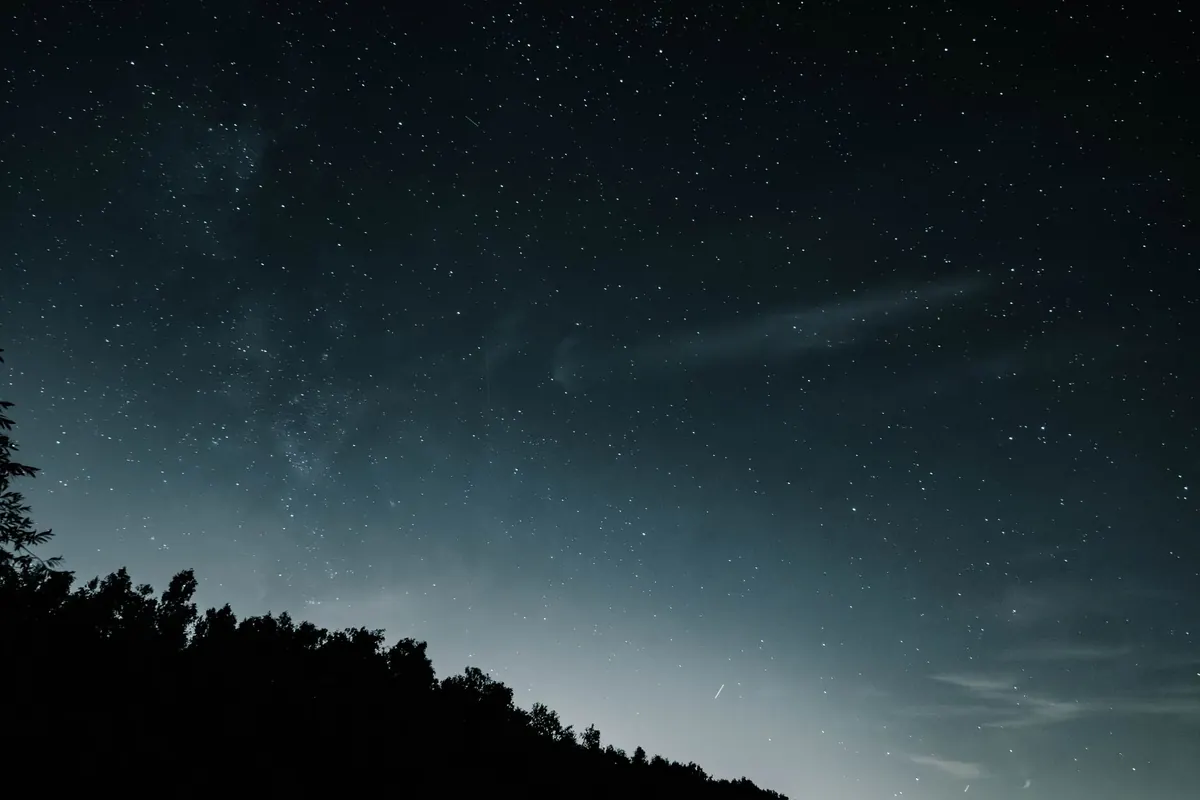
The best satellite-spotting in Britain rarely happens at midnight in January. It happens at dusk in May, when the sky over your garden is still a deep, luminous blue and a single bright point drifts steadily overhead, silent and unhurried, crossing the whole sky in four or five minutes.
That is the International Space Station, and it is one of the easiest things in the night sky to see. The catch is timing. Look at the wrong hour and you will stand in the cold watching nothing, while the station sails over the Atlantic unseen. The same is true of the Starlink "trains" — those strings of evenly spaced satellites that appear briefly after a launch, then spread out and fade into the general background of orbiting hardware.
Here is how the year works, and how to plan around it.
The one rule that explains everything
Satellites shine by reflected sunlight. No glowing of their own, no running lights. That gives you two conditions that must be true at the same time: the satellite must still be in sunlight, and you must be in enough darkness to see it against the sky.
This is why the useful windows are the couple of hours after sunset and the couple of hours before sunrise. At midday the station is brilliantly lit, but the sky is far too bright to pick it out. At two in the morning in midwinter it may be overhead, but it is often inside Earth's shadow and simply not there.
The rule also explains the seasons. Around the June solstice, the Sun never drops far below the horizon in Britain. The ISS can stay sunlit for an entire 90-minute orbit, so it becomes visible at eleven at night, or even later. In December the opposite applies: the nights are long, but the station spends much of them in shadow, so the passes worth catching come early in the evening or just before dawn.
Passes also come in runs. For a few weeks the station favours the evening sky, then it shifts to the morning, then there is a quieter spell when it passes over in daylight or in shadow. Each night the times move a few minutes earlier. If you miss a good run, another is usually a fortnight or so away.
A rough guide to the British year
March to May
Often the kindest months. Sunset lands at a civilised hour, the sky darkens properly by mid-evening, and the station is frequently in a bright, high, sunlit phase. A clear April evening is close to ideal: warm enough to stand outside for ten minutes, dark enough to see everything clearly.
June to August
Twilight lasts all night across northern Britain, and even in southern England true darkness vanishes for a few weeks around the solstice. The upside is that the ISS can appear near midnight, on long, high, slow passes that are spectacular. The downside is that you will be up late, and faint satellites are washed out by the bright summer sky.
September to November
After a lull around the equinox, the station works its way back into the evening. Autumn can be excellent: early darkness, crisp air, and the bonus of occasional meteors while you wait. A cold front that clears the cloud often leaves the clearest skies of the year.
December to February
Long nights, but fewer well-lit passes. Look for the ISS in the early evening, and check the pre-dawn sky too — winter mornings can be very good, because the Sun is still far below the horizon while the station is already lit.
Starlink trains: catching them while they are still in convoy
Immediately after launch, Starlink satellites are released into a low orbit and stay close together, appearing as a line of dim points moving in formation. Over the following days and weeks they raise their orbits and drift apart, and the train dissolves into isolated satellites that are far less impressive.
So the window is short: a few days to a few weeks after a launch. Brightness varies enormously. The newer satellites have darker coatings and are fainter than the early ones, and a train seen from a lit town may be little more than a faint smudge. They are best caught low in the sky shortly after sunset or shortly before sunrise, and they reward patience far more than the ISS does.
Apps and websites that do the arithmetic
Nobody calculates orbital mechanics on the back of an envelope. Let a prediction service do it. A good pass listing gives you five things, and you need all of them:
- the time it starts
- the direction it appears from
- the direction it disappears towards
- the maximum height it reaches, measured in degrees above the horizon
- how bright it will be
Heavens-Above is the long-standing favourite for printable, reliable predictions, and N2YO is useful for tracking. On a phone, ISS Detector, Sky Guide, Star Walk 2 and Stellarium all offer pass alerts and sky maps that show the satellite's path across your own horizon. Add a cloud forecast — Clear Outside or the Met Office — and you have everything you need.
One practical tip: aim for a pass with a maximum elevation above about 40 degrees. Low passes near the horizon are dimmer, shorter and easily hidden by rooftops.
Where to stand
Here is the reassuring bit. The ISS is bright enough to be seen from a city street, a suburban back garden or a flat balcony, so do not plan an expedition for it. What matters is a clear view from roughly west to east, away from streetlights shining directly into your eyes, and no trees or buildings blocking your sightline.
Starlink trains are a different matter. For those, real darkness helps. Britain has a good choice of designated dark-sky areas: Galloway Forest Park, Exmoor, the Brecon Beacons, Northumberland National Park, Snowdonia, the Yorkshire Dales and the South Downs among them, plus islands such as Sark and Coll. Even then, the most important variable is cloud, not light pollution.
A first-attempt checklist
- Check the predictions in the morning for that evening, or the night before.
- Pick a pass higher than 40 degrees if you can.
- Note the start time, the direction it appears and the direction it vanishes.
- Go out five minutes early and let your eyes adjust. Dim your phone screen.
- Look for a steady point of light, brighter than any star, moving smoothly and silently. No flashing, no navigation strobes, no engine noise — that is how you tell it apart from an aircraft.
- If it fades and disappears halfway across the sky, you have just watched it enter Earth's shadow.
Making peace with British weather
Cloud is the real obstacle, and it will beat you more often than a bad prediction will. The trick is to treat it as a series of short chances rather than one big event. Keep a warm layer by the door and be willing to step outside for five minutes when a gap opens. Saturday evenings after a cold front often deliver the clearest skies.
And leave the binoculars in the cupboard. Satellites cross the sky too quickly to track comfortably through them, and the naked eye gives you a wider view of the whole pass from horizon to horizon. On a clear spring evening, that is all you need.
Photo: Léo Gilmant / Pexels